Three SAT® administrations from March through June 2026 reveal a test that is no longer about what students know—it's about how they think when knowledge alone isn't enough. March's Math Module 2 was unexpectedly brutal, leaving students who scored 1450–1520 on practice tests feeling blindsided by parameter-heavy algebra and multi-step geometry. May shifted the struggle to English Module 2, where students encountered longer transition phrases and density that Bluebook practice materials hadn't prepared them for. By June, both sections settled into a consistent pattern: Module 2 tests reasoning under fatigue, not content mastery. The emotional arc moved from shock (March) to strategic recalibration (May) to acceptance with anxiety management (June). Across all three administrations, one signal remained constant: students who normalized Module 2 difficulty performed better than those who treated it as an anomaly.
Reading & Writing
Module 1
- Vocabulary required nuanced interpretation rather than simple recall. Words like eschew, unequivocal, and counterintuitive appeared frequently, testing connotation and context sensitivity.
- Passages on cultural topics (indigenous art, cross-cultural semiosis, language families) rewarded students who could adapt quickly to unfamiliar contexts.
- Grammar questions felt standard, though some students noted that typical test-taking shortcuts for pronoun agreement didn't work as reliably.
- Overall, Module 1 was manageable, and most students reported completing it without significant time pressure.
Module 2
- Transitions became a recurring pain point. Students flagged questions where longer, multi-word transition phrases carried logical weight—not just single words like "however" or "furthermore."
- Inference questions required tracking relationships between multiple concepts. Answer choices often looked plausible, creating hesitation and second-guessing.
- Passages felt longer than Module 1, and students reported lower confidence in their answers. Many asked peers to validate their choices.
- Data interpretation questions (particularly those involving charts and studies) generated more confusion than humanities-based passages.
Math
Module 1
- Widely perceived as easier and more predictable than Module 2. Students reported completing this module with confidence and time to spare.
- Questions aligned with Bluebook expectations, reducing surprises for those who had practiced consistently.
Module 2
- Parameter-heavy algebra dominated. Students reported encountering multiple problems requiring them to factor polynomials with specific constraints and combine results across different forms.
- Trigonometry questions lacked clear constraints; one student noted a problem that asked about trigonometric ratios without specifying whether a triangle contained a right angle—a frustration under timed conditions.
- Multi-step word problems embedded in lengthy reading contexts consumed significant time. One student described a problem about Earth's curvature and line-of-sight distances that required both comprehension and calculation.
- Geometry (triangular prisms, pyramids, arc length) required careful spatial reasoning. Several students ran out of time on the last six to seven questions despite strong Module 1 performance.
- Timing collapse was the defining feature. Even students with 1450–1520 practice test scores reported being blindsided by this module's complexity and pace.
Detailed Insights from the May 2, 2026 SAT®
Reading & Writing
Module 1
- Vocabulary remained nuanced: students reported encountering attrition, analogous, and other high-frequency academic words. The challenge was subtle distinction between near-synonyms in context, not obscurity.
- Passages required careful reading. Students noted fewer "obvious" answers and more instances of choosing between two plausible options.
- Grammar questions focused on punctuation and verb tense, with subtle ambiguity creating hesitation.
Module 2
- The transition question evolved. Instead of single-word transitions, students encountered longer phrases (5–10 words) that functioned like mini-reading-comprehension questions. This format shift caught even well-prepared students off guard.
- English Module 2 felt noticeably harder than Bluebook practice tests. One tutor noted: "English modules felt harder than what most students experienced in Bluebook tests."
- Passages were denser and more time-consuming. Students reported needing to engage with context more deeply, moving beyond surface-level comprehension.
- Vocabulary on this test leaned toward the harder end, though reactions were idiosyncratic. Some students reported finding it much harder; others found it easier than May. This suggests vocabulary difficulty varied by form or perception.
Math
Module 1
- Generally straightforward with alignment to practice expectations. Students noted this module felt more predictable than March's equivalent.
Module 2
- Systems of equations with parameter constraints appeared, requiring deeper reasoning than Desmos could provide alone. Students had to understand mathematical logic, not just plug in numbers.
- Y-intercept questions appeared with notable frequency, both in linear and exponential contexts. This is a high-probability concept for focused prep.
- Exponential growth equations, particularly those with offset starting points, created confusion. Multi-step percentage calculations were tricky for students who tried to add percentages rather than multiply factors.
- Geometry remained challenging (cylinders, rectangular prisms, ratios). The difficulty came from multi-step setup, not from unfamiliar concepts.
- Overall, Math Module 2 difficulty felt more predictable than Reading Module 2, and students reported slightly more confidence on this section compared to March.
Detailed Insights from the June 6, 2026 SAT®
Reading & Writing
Module 1
- Vocabulary list was extensive and academic: eschew, disparate, precarious, oblique, tantamount, resilient, correspondence (with dual meanings), and latitude (with dual meanings) all appeared.
- Students reported standard difficulty; vocabulary didn't generate complaints at rates comparable to March or May.
- Grammar and transitions were generally manageable. Module 1 felt like a solid warm-up for Module 2.
Module 2
- Reading passages became the primary struggle. Multiple interconnected ideas within single passages required students to track logical relationships, not just extract surface facts.
- Inference questions were omnipresent. Students reported difficulty distinguishing between plausible and correct answers, particularly when two options seemed defensible.
- Pacing pressure intensified. One student noted getting 27/27 on Module 1 but only 22–23/27 on Module 2, suggesting a shift in confidence under fatigue.
- Students who had practiced under Module 2 conditions (fatigue, density) reported better performance than those who hadn't simulated that environment.
Math
Module 1
- Generally perceived as stronger and more accessible than June's Reading Module 1. Confidence remained high.
- Students completed this module with less time pressure, contrasting with March's experience.
Module 2
- Arc length and circle geometry questions appeared (one student asked directly about an arc length question as a routing indicator).
- Multi-step geometry and graph interpretation dominated the final questions.
- Several students reported "the last 6 wrong" despite strong Module 1 performance, suggesting the difficulty jump was pronounced.
- Interestingly, some students scored 760+ on Math despite making 4–6 errors, while others reported lower scores with similar error counts. This variability suggests form difficulty or strategic guessing played a role.
Cross-Cutting Themes Across March, May, and June 2026
- Module 2 is the test's core mechanism, not an anomaly
.All three months showed consistent difficulty elevation in Module 2, with students expecting and planning for this shift by June. The adaptive structure is working as designed. - Math Module 2 is more variable across forms than Reading/Writing Module 2. March and June both showed time collapse in Math Module 2, but May's Math Module 2 felt more predictable. Reading Module 2, by contrast, showed consistent difficulty across all three months. This suggests the College Board has tighter control over Reading/Writing difficulty.
- Vocabulary is no longer the main bottleneck. All three months show students reporting vocabulary as solvable. The shift from vocabulary difficulty to reasoning-under-ambiguity difficulty is complete.
- The Bluebook gap is real and matters. May explicitly surfaced this: students found official practice materials easier than the actual test. By June, students seemed less surprised, suggesting they'd adjusted expectations.
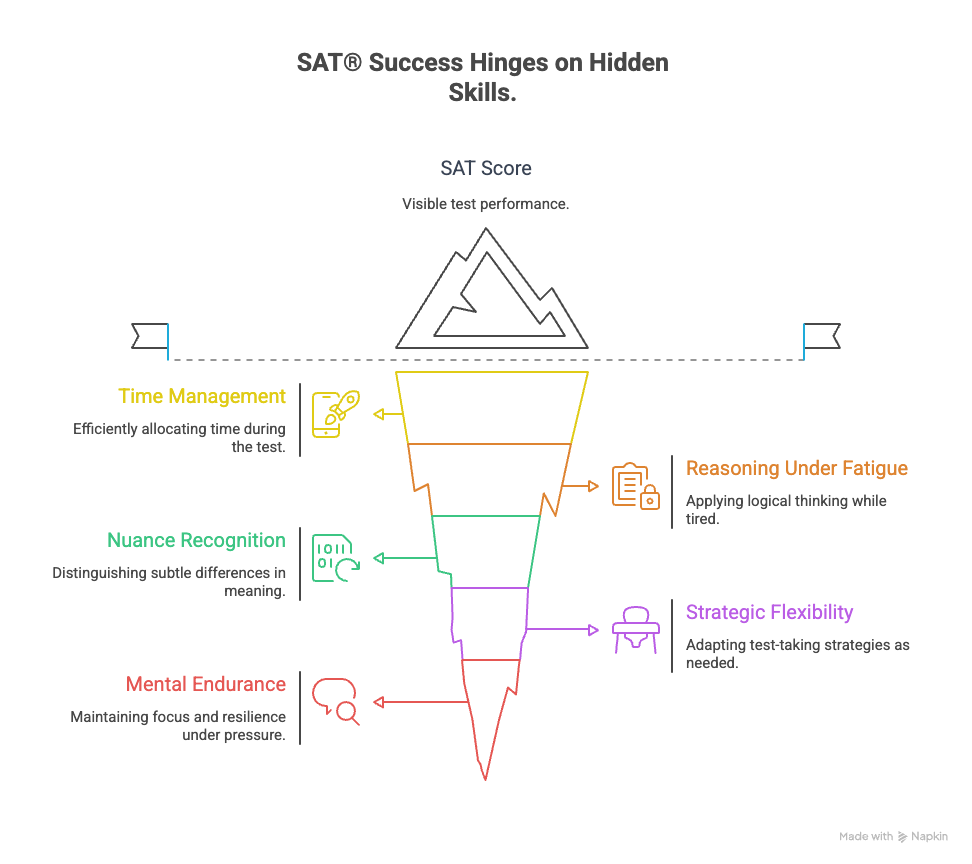
- Reasoning and pacing beat content. Across all three months, students who reported studying conceptual understanding and time management performed better than those who reported drilling formulas or vocabulary.
- Equating is becoming part of student consciousness. In March, students asked "how does CB decide whether to take 20 points or 10?" By June, students understood (or believed they understood) that different questions carry different point weights and that harder tests would be equated more generously.
Differences Between March, May, and June
- March leaned heavy on parameter-heavy algebra and multi-step geometry (triangular prisms, pyramids, trigonometry). May and June showed more balanced geometry and algebra.
- March vocabulary included older academic terms. May and June vocabulary leaned toward high-frequency academic words (attrition, analogous, precarious, unequivocal).
- May introduced the transition question format shift (longer phrases), which became a recognizable pattern by June but caught students off guard in May.
- March and June showed consistent Math Module 2 time collapse. May's Math felt more manageable, suggesting form variation or student adaptation.
- Emotional arc: Shock and venting (March) → Tactical strategizing and form variation awareness (May) → Resignation with routine anxiety management (June).
Implications for Prep
Reading and Writing
- Prioritize inference and reasoning under ambiguity drills. Vocabulary is solvable; reasoning is the differentiator.
- Practice transition questions explicitly, including the newer, longer multi-word phrases. This format is evolving faster than Bluebook captures.
- Build regular exposure to dense passages with multiple interconnected ideas. Students need to practice tracking logical relationships, not just extracting facts.
- Simulate fatigue: practice two-module runs in one sitting to build mental endurance and accustom students to performing under declining confidence.
Math
- Emphasize multi-step setup over formula memorization. Students who understand "what am I solving for" before reaching for Desmos perform better.
- Focus on parameter-based reasoning: systems of equations with constraints, exponential growth with offsets, percentage chains.
- Train geometry reasoning (ratios, similar shapes, solid geometry) with emphasis on spatial understanding, not rote formulas.
- Practice time-boxing: if no clear approach emerges in 40–50 seconds, flag and move. Module 2 time collapse is often due to lingering on early mistakes.
- Build Desmos fluency as a verification and exploration tool, not a solution shortcut.
Test Readiness
- Prepare for the Bluebook gap: actual test is harder in reasoning, inference, passage density, and multi-step setup. Practice should be slightly harder than official materials.
- Normalize Module 2 as the real test. Module 1 is a qualifier; Module 2 is where reasoning is tested. Build psychologically for this.
- Develop pacing discipline: students who preserve time for Module 2 questions (rather than spending excess time on Module 1) report better overall performance.
- Practice emotional reset between sections and between modules. Simple cues ("Next question. Fresh start.") reduce mid-test spiral.
Strategy
- Work backwards when needed. Some students succeed by tackling later questions first to avoid early time sinks that cascade into Module 2 pressure.
- Justification before lock-in. Encourage students to articulate "why this answer" before committing, reducing second-guessing.
- Two-strike rule. If no clear approach in ~40 seconds, attempt once more, then skip. Protects time for solvable questions.
- Practice under fatigue. Place hardest question sets at the end of practice sessions to simulate real Module 2 conditions.
- Expect variability by form. Different students reported different difficulty experiences on the same test date. This is normal and suggests form variation exists even within an administration.
At this stage, many students turn to guided platforms like Sherpal for structured, adaptive practice that mirrors test-day conditions and builds reasoning-first discipline. If you are serious about improving performance, you can Register Here and get access to adaptive prep tools and strategies.
So What?
For parents, the key takeaway across March, May, and June 2026 is this: the SAT® is testing a different skill set than it did five years ago. It's no longer about vocabulary breadth, formula recall, or pattern recognition. It's about reasoning clearly when multiple answers seem defensible.
- Module 2 is not an anomaly. It's the test's core mechanism. Students should expect it, plan for it, and practice for it.
- Bluebook is a foundation, not a ceiling. Official practice materials are easier than the actual test, particularly in Reading/Writing Module 2.
- Vocabulary is solvable. Reasoning under ambiguity is not. The biggest score gaps come not from missed vocabulary, but from hesitation when two answers feel equally plausible.
- Pacing determines outcomes. Time management beats content knowledge. Students who preserve time for Module 2 and skip strategically outperform those who attempt every question.
- Emotional adaptation is as important as content prep. Students who normalized Module 2 difficulty by June performed better than those who treated it as a surprise. Mindset matters.
- The test rewards flexible thinkers. Students who adapted strategies mid-test (when to use Desmos, when to skip, how to reset after a mistake) outperformed those who rigidly followed a single approach.